Uniform Resource Identifier(URI)⚓︎
In web development we always say
endpoints. The concept refers toURI+HTTP request method(GET, POST, etc.). So what isURI, what is the difference betweenURIandURL?
Definition⚓︎
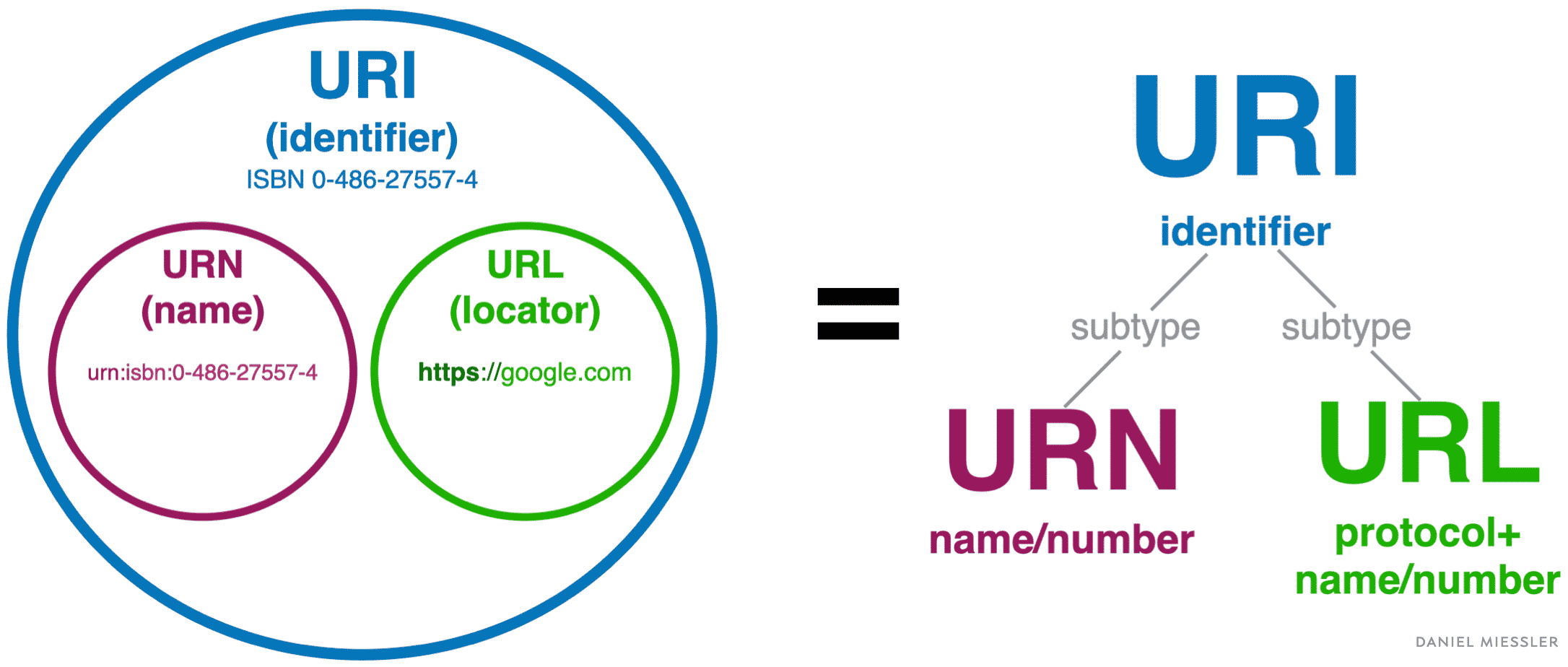
What is URI and URL
-
URI: Uniform Resource Identifier. -
URL: Uniform Resource Locator.
Difference⚓︎
Difference between URI and URL?
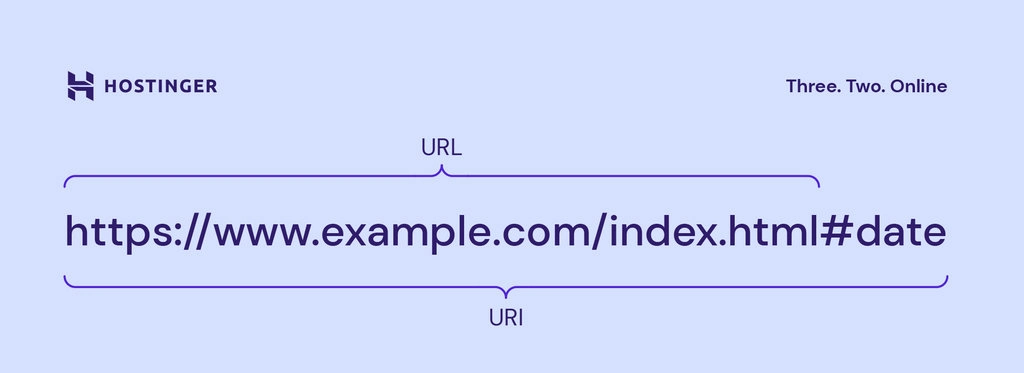
URIidentifies a resource and differentiates it from others by using a name, location, or both.URLidentifies the web address or location of a unique resource.
Syntax⚓︎
Syntax of URI/URL
scheme:[//authority]:port/path?query#fragment
The first component of a URI defines the addressing system:
- in some cases, it is a protocol used to access a resource.
- meanwhile, other techniques may NOT specify any protocol.
Scheme can contain any combination of letters, digits, plus signs, periods, or hyphens followed by a colon. The most common URI schemes include HTTP, HTTPS, FTP, mailto, and file.
HTTP, HTTPS, and FTP
HTTP(Hypertext transfer protocol) – allows users to access data from web pages using hypertext links.HTTPS(Hypertext transfer protocol secure) – protects data transmission between the user’s browser and site.FTP(File transfer protocol) – used for a file transfer between different devices via a network.
e.g. file:website.com/pathtofile/intro.pdf
An optional component preceded by a double slash and terminated by a slash, a question mark, or a hash symbol. It consists of three sub-components:
- Userinfo – includes a
usernameand apasswordseparated by a colon. - Host – consists of either an
IP addressor aregistered name. The IP address should be inserted into brackets. - Port – a
protocolused for connecting the server. It is an optional sub-component followed by a colon.
e.g. file:(//)website.com/pathtofile/intro.pdf
The port of HTTP is 80 by default, while HTTPS uses port 443. If the port is the default for the scheme, it can be omitted.
The thrid component contains a sequence of data segments that describes the location of a resource in a directory structure. It should be empty or separated by a slash.
e.g. telnet://192.0.2.16:80/ (valid URI with an empty path)
e.g. foo://info.example.com ?fred (valid URI with an empty path)
e.g. file:(//)website.com/pathtofile/intro.pdf
A component that contains a query string of non-hierarchical data. It is often a string of key=value pairs. This component is preceded by a question mark.
e.g. https://example.org/test/test1?search=test-question#part2
This optional component includes a fragment identifier that provides the direction to a secondary resource. A fragment is preceded by a hash symbol and terminated by the end of a URI.
e.g. https://example.org/test/test1?search=test-question#part2

