DNS⚓︎
The largest read-only mainly distributed query system in the internet.
Overview⚓︎
From the transport layer, we have TCP/UDP protocols to construct reliable/unreliable connections between two machines with IP addresses. However, to create a new connection with a remote process, we need to know the IP address of that machine1. Remembering IP addresses for every website or service we want to access is impractical for humans. (Unless you want to use 172.217.16.206 to access Google every time. 😅)
DNS (Domain Name System) is a hierarchical and decentralized naming system for computers, services, or other resources connected to the Internet or a private network. It translates human-readable domain names (like www.example.com) into IP addresses (like 192.0.2.1).
DNS Abstract⚓︎
DNS Hierarchy⚓︎
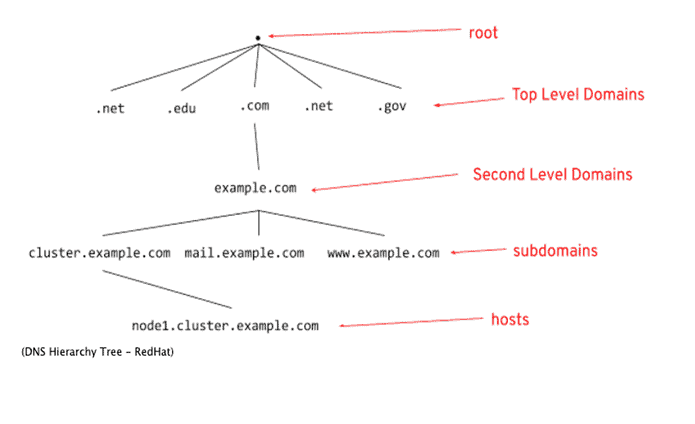
The DNS system is organized in a hierarchical structure, with different levels of authority. The hierarchy consists of several components:
- Root Level: The topmost level of the DNS hierarchy, represented by a dot (
.). It contains information about the top-level domains (TLDs). - Top-Level Domains (TLDs): The next level in the hierarchy, which includes generic TLDs (gTLDs) like
.com,.org, and.net, as well as country-code TLDs (ccTLDs) like.uk,.jp, and.de. - Second-Level Domains: These are the domain names registered under TLDs, such as
exampleinexample.com. - Subdomains: These are additional divisions of a domain, such as
wwwinwww.example.com.
DNS Implementation⚓︎
DNS Server Hierarchy⚓︎
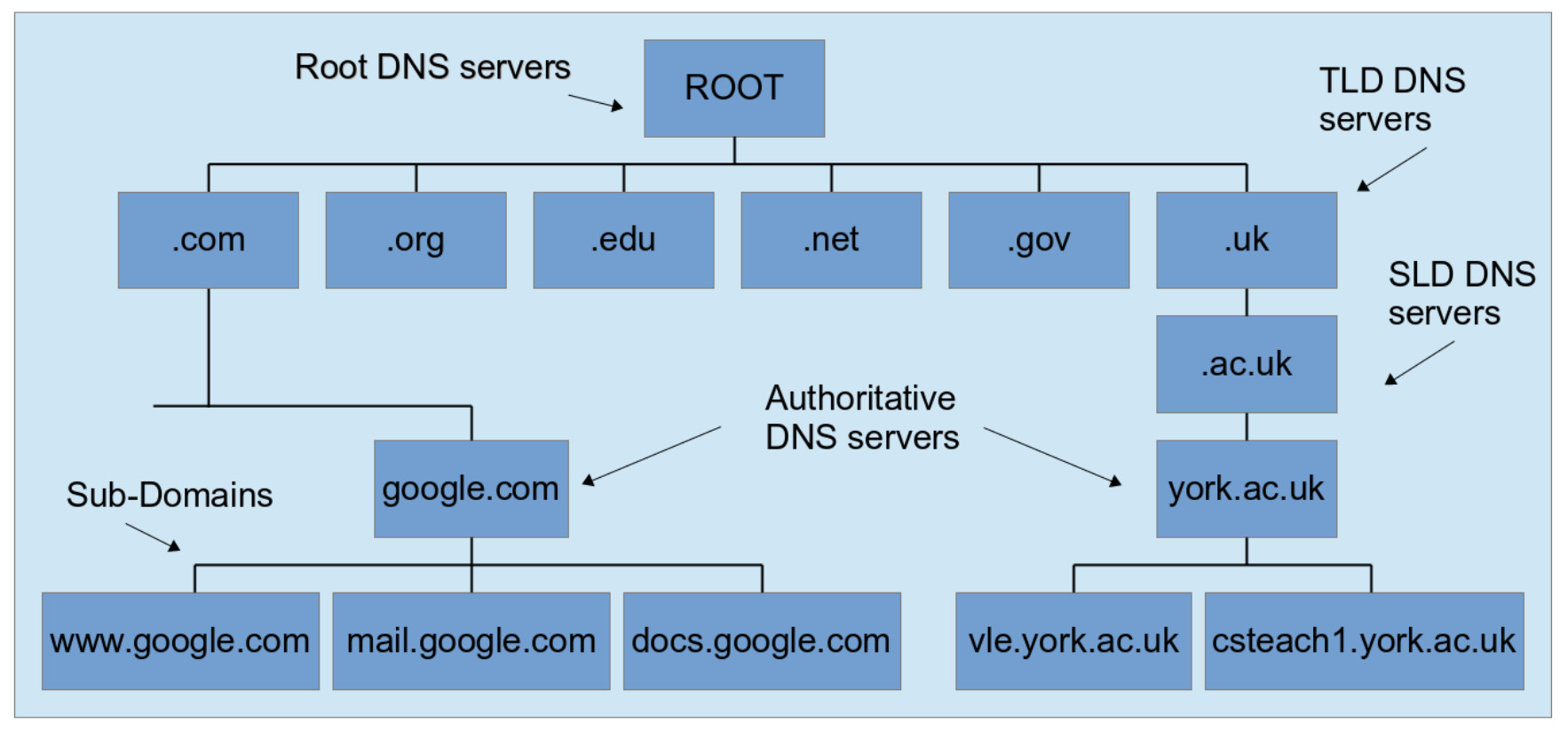
The DNS system is implemented as an application layer service, which runs on servers that sit at the network's edge 2. Those servers are also organized in a hierarchical manner, similar to the DNS hierarchy itself:
Query Types of Servers⚓︎
There are two main types of queries between servers:
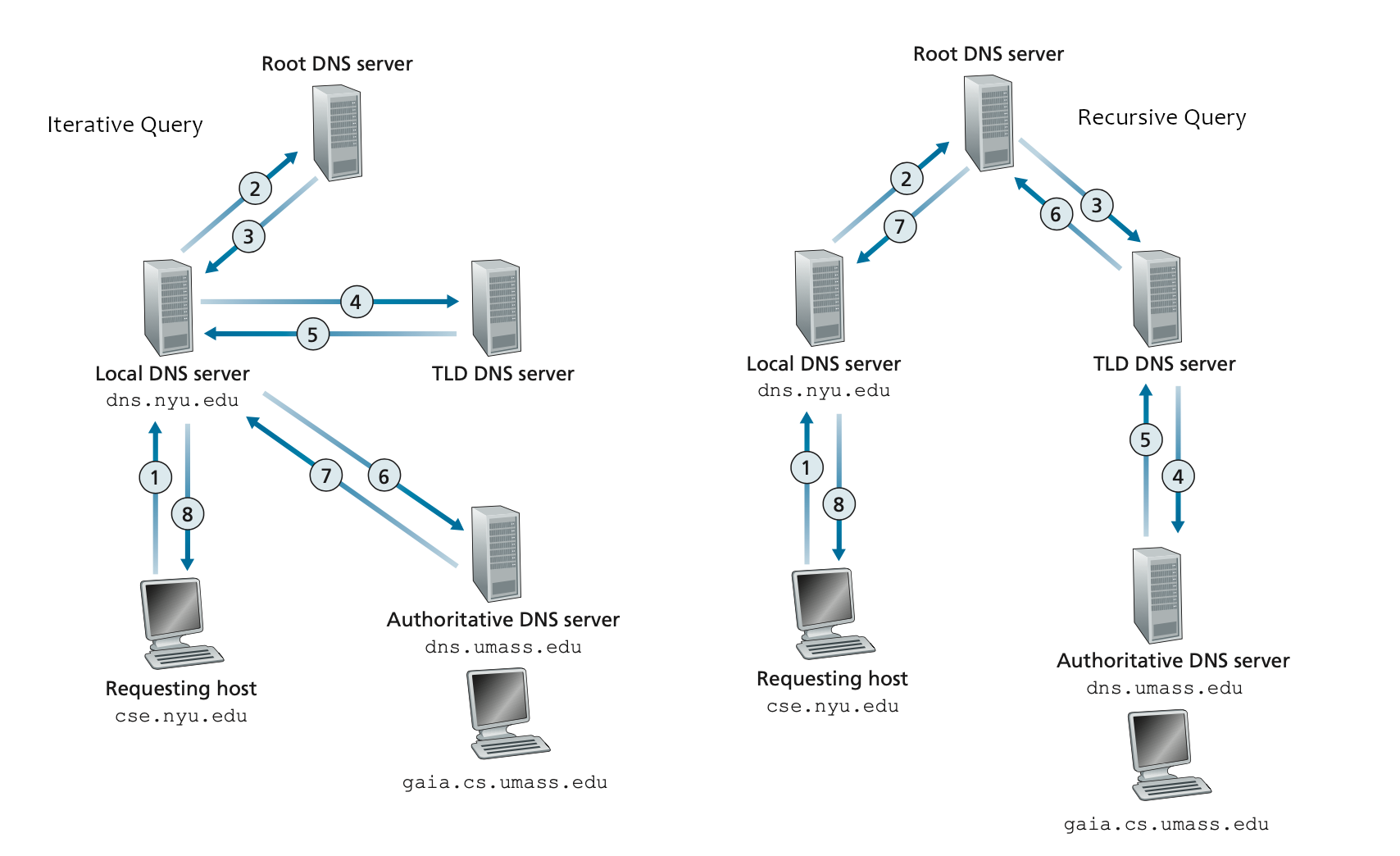
- Iterative Query: iteratively queries each DNS server in the hierarchy until it finds the authoritative server for the requested domain.
- Recursive Query: recursively queries DNS servers on behalf of the client until it finds the authoritative server for the requested domain.
DNS Resolution⚓︎
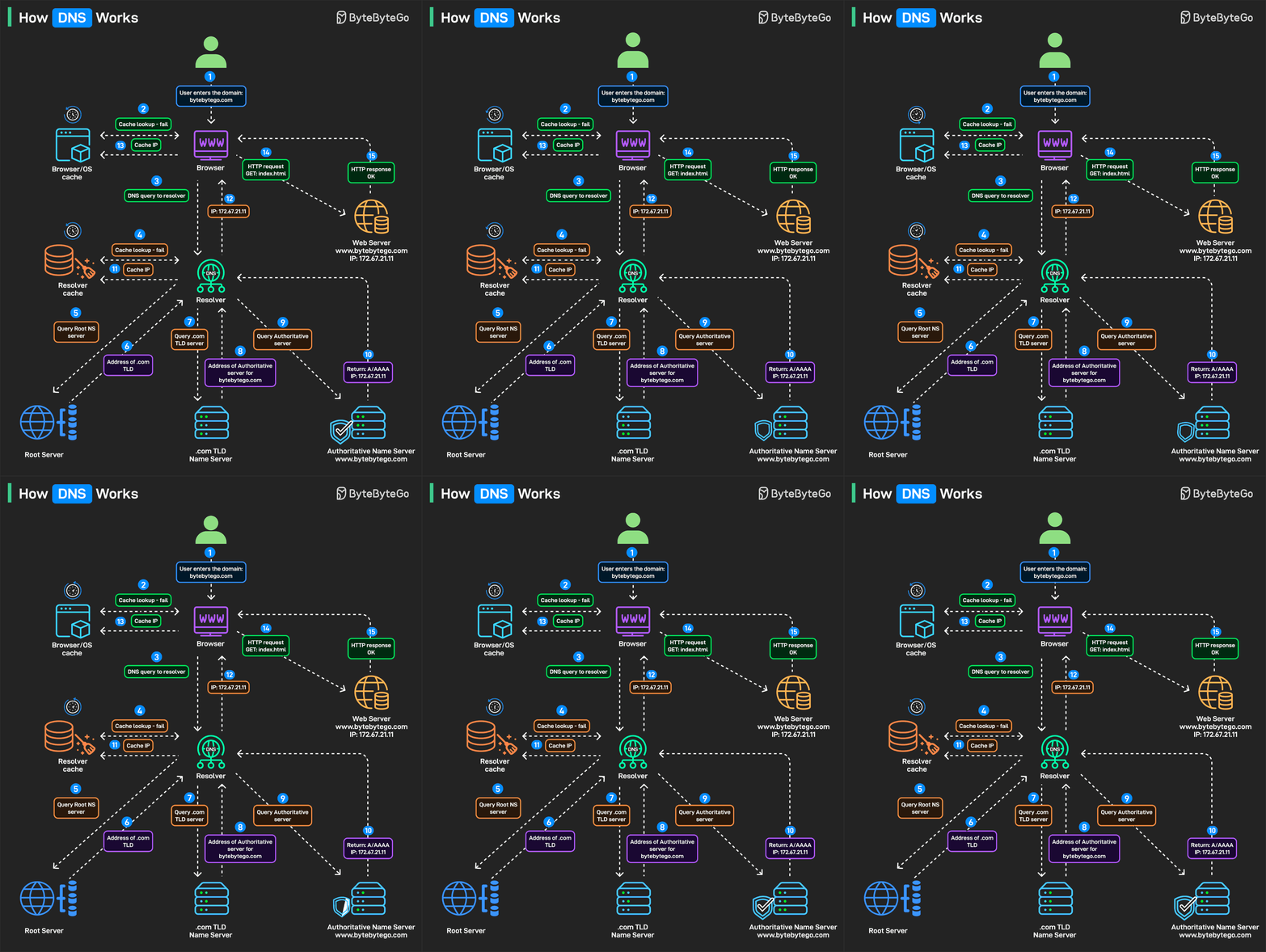
In most of real-world applications, both types of queries are used in the DNS resolution process: the client sends a recursive query to the local DNS resolver. Then the DNS resolver performs iterative queries to find the authoritative DNS server for the requested domain:
DNS Resolvers
As you can see from above, when you type a URL into your web browser, your computer always sends a request to a DNS resolver to find the corresponding IP address. The DNS resolver is responsible for querying various DNS servers in a hierarchical manner until it finds the correct IP address and returns it to your computer. Popular public DNS resolvers include:
- Cloudflare DNS
- Google Public DNS
- Amazon Route 53
Caching & TTL
To improve performance and reduce the load on DNS servers, DNS resolvers often cache the results of previous queries on the local machine. Each DNS record has a Time to Live (TTL) value that specifies how long the record should be cached before it is considered stale and needs to be refreshed.
DNS Record types⚓︎
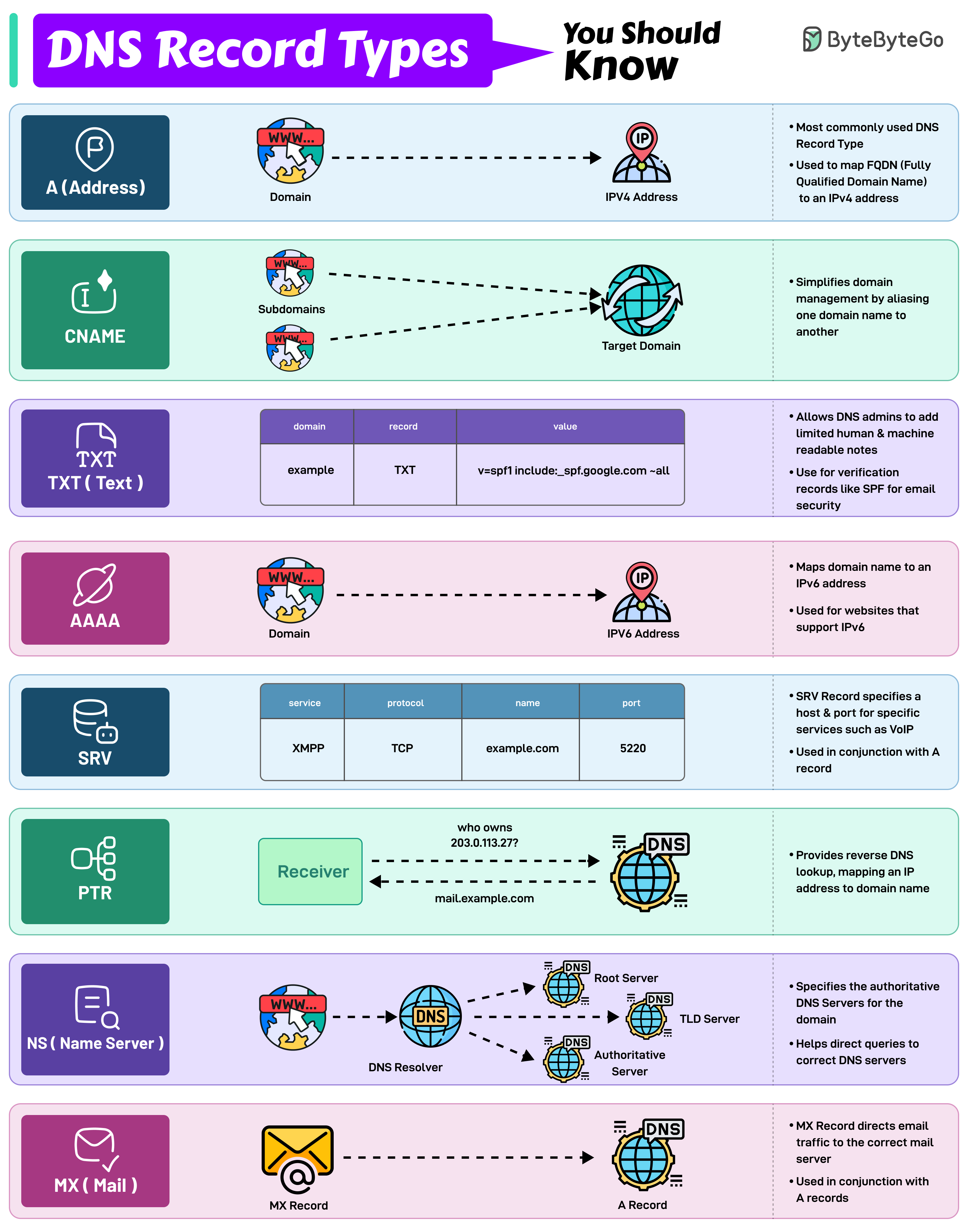
Below images show some common DNS record types and their functions:
DNS in Cybersecurity⚓︎
DNS is security-critical because it determines where trust is established before any application-level protocol is involved.
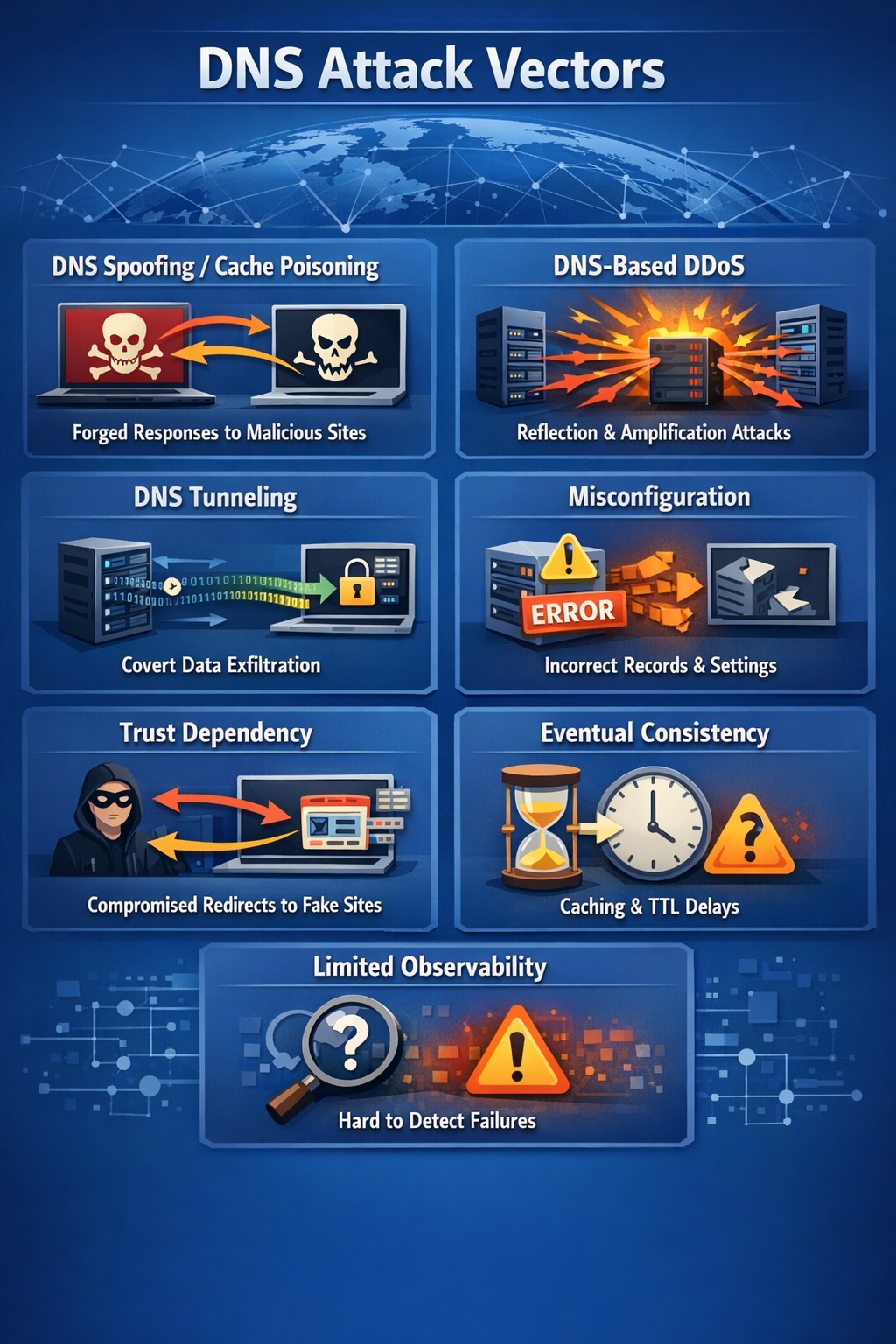
DNS Attack Vectors (Weaknesses)⚓︎
- DNS spoofing / cache poisoning: forged responses redirect users to malicious sites
- DNS-based DDoS: reflection and amplification attacks abuse open resolvers
- DNS tunneling: covert data exfiltration or command-and-control via DNS queries
- Misconfiguration: incorrect records or delegation can take services offline
- Trust dependency: compromised DNS can silently redirect users to fake destinations
- Eventual consistency: caching and TTL delay changes and incident recovery
- Limited observability: DNS failures are often hard to detect and diagnose
DNS Security Controls (Mitigations)⚓︎
- DNSSEC: cryptographic validation of DNS responses to prevent spoofing
- Rate limiting & Anycast: mitigate DNS-based DDoS attacks
- DNS firewalling: block malicious or suspicious domains at the resolver level
- Traffic analysis: detect tunneling via query patterns, entropy, and frequency
- Operational controls: configuration validation, monitoring, and change management